This webpage serves as a centralized guide, linking users to trusted implementation resources across every stage of the prevention process.
Read more below.
Prevention science uses a public health approach to support healthy development and reduce the likelihood of problems before they begin. It focuses on reducing risk factors – such as chronic stress, social isolation, and limited access to positive opportunities – that increase the likelihood of challenges like substance use, violence, or academic difficulties. It also promotes protective factors – such as supportive relationships, strong school and community connections, and healthy coping skills – that reduce those risks.
The River Story is a public health metaphor that brings this idea to life and illustrates what is often called Upstream Prevention.
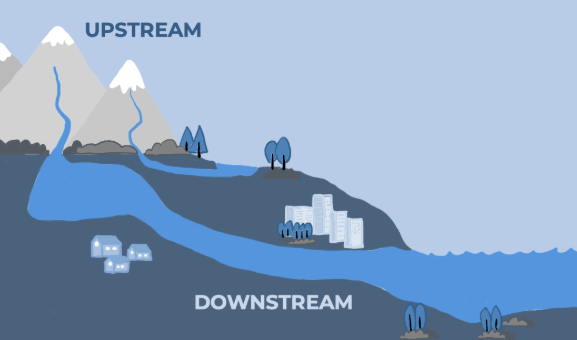
A common version goes like this:
- Imagine a large river that starts near the top of a mountain.
- At the bottom, several people are frantically trying to rescue those who have fallen into the river, many of them drowning.
- One rescuer asks, “Where are you going?” as another rescuer runs upstream and responds: “I’m going upstream to find out why so many people are falling into the river.”
- Upstream, the rescuer sees stable and unstable bridges – some in good condition, others in disrepair.
- Those crossing unstable bridges are more likely to fall, while those on stable bridges are better protected.
- This example highlights that the underlying causes of problems are often found in the conditions upstream, not only in the efforts to respond after harm occurs.
The River Story shows that prevention is more sustainable and cost-efficient than reacting to problems after they arise by effectively addressing upstream causes – such as key risk and protective factors – before problems develop.
Within this approach, prevention occurs at different levels and can be tailored based on level of need:
- Primary prevention focuses on strengthening the conditions that support healthy development – such as positive relationships, coping skills, and strong community connections – often through universal programs designed for everyone, before problems develop.
- Secondary prevention focuses on addressing elevated risk by providing additional support to individuals or groups facing greater challenges, often through selective programs.
- Tertiary prevention focuses on reducing the impact of challenges that have already developed by supporting individuals showing early signs of potential problems, often through indicated programs.
Together, these complementary approaches help communities identify and respond to needs as early as possible, match programs to different levels of need, and promote long-term well-being. For many health problems, a combination of primary, secondary, and tertiary interventions is needed to achieve a meaningful level of prevention and protection.
Blueprints for Healthy Youth Development supports upstream prevention efforts by sharing information about primary, secondary, and tertiary prevention programs shown through rigorous research to improve outcomes for children, youth, and families. Blueprints helps communities understand which prevention programs are effective, what outcomes they address, and the strength of the evidence – making research easier to use in real-world decision-making.
Selecting a program from the Blueprints registry is an important step in identifying evidence-based solutions to meet your community’s needs. These programs are most effective when communities have the tools to implement them well. Implementation resources, such as Colorado State University’s Prevention Research Center Implementation Toolbox and the Prevention Learning Portal, support putting evidence-based prevention programs into practice. These open-access tools help users assess community needs, plan implementation, monitor program quality, make thoughtful adaptations, evaluate progress, and sustain programs over time.
The following figure illustrates this idea:
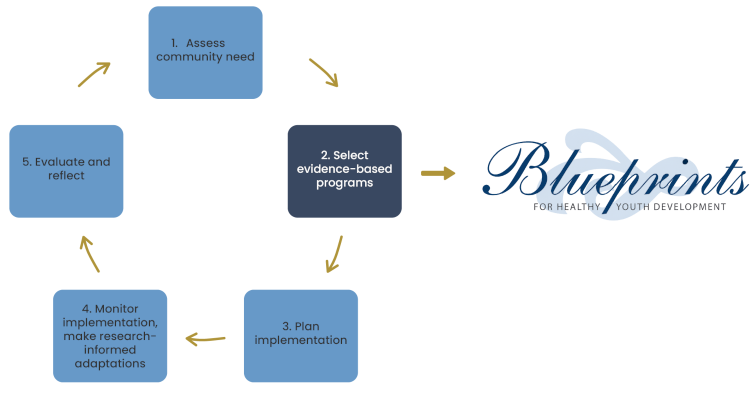
Together, Blueprints, the Implementation Toolbox, and the Prevention Learning Portal provide complementary support, helping communities move from identifying effective programs to successfully implementing them in real-world settings.
This webpage serves as a centralized guide, connecting users to these trusted resources across every stage of the prevention process.
Implementation Online Resources
Our convenient online implementation resources section provides a filterable database of resources.
What You’ll Find in the Implementation Resources
The Implementation Resources page provides a wide range of practical tools and guidance to support communities in understanding, selecting, implementing, and evaluating prevention programs.
To help you find what you need, the resources are organized into the following areas:
- Preventing youth problems overview – Foundational information to understand prevention and how it supports healthy development
- Building coalitions and engaging communities – Guidance on bringing partners together and strengthening community involvement
- Creating a positive school climate – Resources to support safe, supportive, and connected learning environments
- Understanding how a program works – Understanding how prevention programs are developed
- Implementing a program with fidelity – Support for delivering programs as intended to achieve desired outcomes
- Adapting a program – Research-informed guidance for making thoughtful changes to fit community context while maintaining effectiveness
- Evaluating program benefits – Tools for assessing progress, understanding impact, and improving outcomes over time
To get started, click here to access the Implementation Resources and choose the category or categories that best match your current goals and needs.